The current obsession in my household is over ebikes. Does this sound familiar?
My tween and teen ask me for one incessantly. Their relentless begging, pleading, tantrum-throwing tactics really wore me down. Intuitively, I felt the answer was no, given the number of teen ebikers that are riding around our community in unsafe ways, but given my kids’ passion, I researched the situation to provide a more firm, thought-out response.
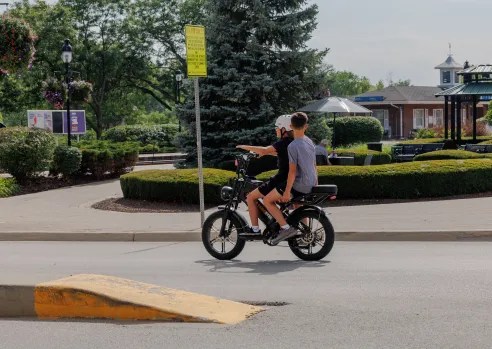
After the research, my answer to their question is still “No, I will not buy you an ebike.” At least not now. I summarized my reasoning in writing and now direct my kids to this summary because I became tired of repeating myself day after day. Each family has their own risk tolerances and circumstances, so my conclusion may not be yours. Below is the research briefing and FAQs that I provided to my kids.
Can I have an ebike?
The answer is “no” on 2 levels.
- At the first, pre-requisite level, the question is: Is an ebike an appropriate thing for you to have?
- If the answer is yes, then we move to the 2nd level question, do you deserve to have one or does it make sense for you to have one? The answer to this is based on your behavior (if you have earned it by behavior or work), the costs and types of ebikes, evolving ebike laws, planned usage, etc.
Right now, we are stopped at first level because the answer is no for safety reasons.
Safety Reasons
The safety reasons are broken into 2 categories: external factors and rider decisions.
The external category encompasses all the things that are not in your control. Riding bikes on the streets has always been dangerous. Electric or not, riders have to share the road with cars and are at the mercy of large heavy cars, driven by distracted drivers, hurried drivers, student drivers, and elderly drivers who may not see the bikers, who may not react in time, and who may themselves not be following traffic rules. The roads are simply not set up to be cyclist-friendly. It is not just about how careful you will be.
Rider decisions include all the things that the rider may do. Unsafe riding often occurs because kids at this age do not have enough situational awareness (this is awareness of traffic flow, what is happening on the road around them, driver intentions, cars in driveways, pedestrians and dogs on sidewalks, assessment of risks, distance to brake, visibility at dusk/dark, etc.) Ebike or not, kids are often not aware enough of the bicycle laws and how they are supposed to interact with local traffic. Then these dangers are compounded at the higher ebike speeds.
Furthermore, the adolescent years are when kids are very likely to take risks without thinking through or realizing the consequences. Data collected in Marin since 2023 have shown that e-bike riders ages 10 to 15 have a crash rate that is five times higher than other age groups. They are also heavily influenced by peers and what they do, and can easily get caught up in the moment. These factors can result in some bad decisions, such as racing in unsafe places, trying to keep up with each other in unsafe ways, attempting risky stunts, riding on high traffic streets “just this once,” speeding on sidewalks, unpredictable riding that puts drivers on edge, etc.
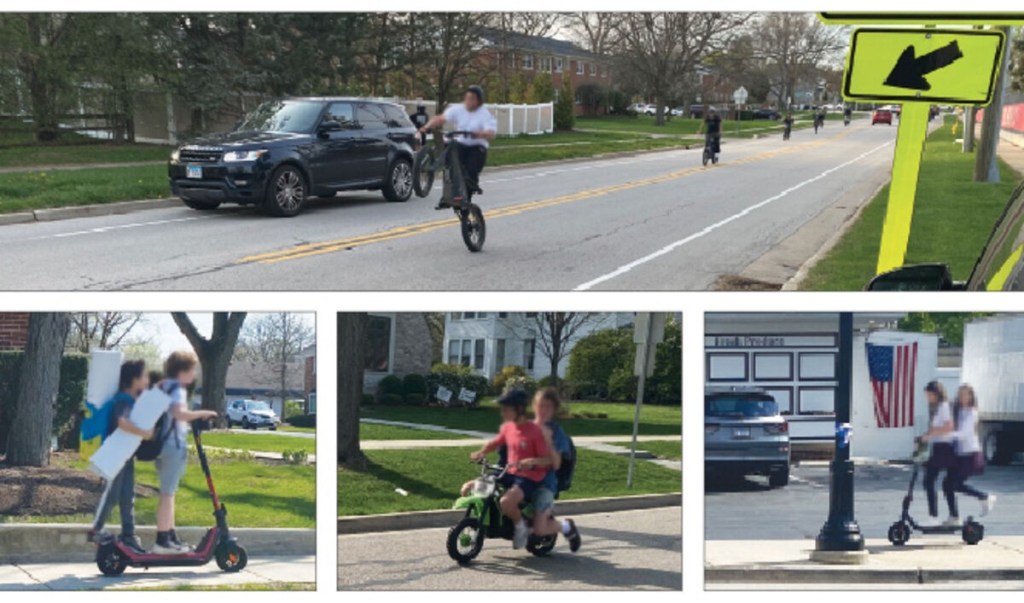
Both these external factors and rider decisions make bicycling risky already and ebiking with its additional speed makes everything that much more dangerous and risky. According to a Danish study, electric bicycle riders are about 57 percent more likely to get into an accident than traditional bike riders. Falls and collisions while riding an ebike are likely to be more severe, due to the higher speeds and usually heavier bikes. Ebike riders had a higher rate of hospitalization (48% vs. 24%) and more severe injuries compared to traditional cyclists. Even an ebike manufacturer states, “A simple bump in the road that is fine at 12 mph can cause complete loss of control at 25 mph.” Doctors report that the injuries kids are getting from ebikes are much worse than injuries they typically see from traditional bike crashes.
Finally, injuries to others is also a possibility and can be more severe because of sidewalk riding (which is sometimes illegal) and collisions with pedestrians, or driveway traffic. E-bike accidents are also three times more likely to involve a collision with a pedestrian. In some cases, both riders and parents (since they bought the ebike for the kid) can be held accountable and/or at fault for injuring others.
Frequently Asked Questions (by my kids about getting an ebike)
Q: But what if I promise to be extra careful and safe? Or only ride on sidewalks? And I will never go above X speed unless it’s in a safe area?
A: I believe that you are sincere with your promise and you have good intentions. However, I can’t be sure that will be true and I look at your past behavior to help me judge. In other areas, I can already see the difficulty you may have in keeping your promises. The easiest example I can think of is the laptop. Think about your answer to the following question: when I give you the laptop to only do homework, how often are you able to only do your homework on it and then put it away? Since you won’t be supervised while on an ebike, your ability to make good rider decisions becomes extremely important.
Q: But 20mph isn’t even that fast, right?
A: First, for reference, a regular cyclist will average speeds 10-15mph, although some riders can do 20mph even on a regular bike. Currently, the ebike speeds in CA are capped at 20mph (even with throttle) and 28mph if you are 16 and over. From some Internet research, it appears that 20mph is plenty fast and from scientific and physics perspective, fast enough that an accident at that speed will be very bad. Some riders initially find that 20mph is frighteningly fast (it feels different than going 20mph in a car), but after a few months, they may become comfortable with it and want to ride at even higher speeds. A big part of why you guys are interested in the ebike is the speed and being able to maintain higher speeds. The higher the speed, the more dangerous it becomes to ride an ebike.
Q: What if I promise to always wear a helmet?
A: I already have trouble getting you to wear a helmet while riding a traditional bicycle which we all agree has risks similar to the ebike. Why don’t you wear the helmet now? Think to yourself for a second. Whatever the reason is that you have for not wearing that helmet now, that reason will likely also be the reason for choosing risky behaviors while on an ebike.
Q: What if I build it myself?
A: No, because then you would have an ebike which I said you cannot have for safety reasons. See above, “SAFETY REASONS.”
Q: What if it is a pedal assist only bike?
A: Theoretically, this could be safer than a class 2; however, it is still primarily a safety issue (see safety reasons above) and secondly, presents an opportunity and temptation to delimit the bike. Again, you may not intend to tinker with it and I believe that you are sincere with your promise and you have good intentions. However, I can’t be sure that you can keep your promise and I look at your past and current behavior to help me judge. For a traditional bike, we are at the 2nd level question and we can consider replacing or upgrading your traditional bike with any non-electric features such as bigger frame, suspension, different wheels, newer brakes, etc.
Q: How can I keep up with my friends who have ebikes when I don’t?
A: Regular bikes can still go quite fast, depending on the rider. As a reminder, regular bikes still have safety considerations, (just without the added risks that ebikes bring). If it makes it harder for you to keep certain friends, that is unfortunate and understandably upsetting. However, in the grand scheme of your life, this is a very brief time and a very very small “difficulty,” if you can even call it that. If you feel very excluded, try to spend more time with different friends and get involved in different activities and broaden your understanding of the world which will also help you understand why having an ebike now is not critical.
Q: Why can’t I have an ebike when it looks so fun and would make my life so much better?
A: It does look fun, but it also adds an unnecessary larger risk of injury that could remove a lot of fun from your life forever. The safety concerns outweigh the fun.
Q: Travelling in a car is risky, too. Why do you let me do that if it’s dangerous too?
A: In the area we live in, it would be difficult to do everyday things without a car, so it is a necessity. An ebike is not a necessity.
Q: Will I ever be able to have an ebike?
A: Possibly. Maybe we will get to the second level question at some point (see above). Many things are evolving with regard to local ebike laws, rider safety, ebike technology, and bike road infrastructure – changes in these areas may make it safer (or less safe). Many things about you are also going to be (hopefully) improving. You will be maturing and practicing making decisions all the time. You may be riding a regular bike often, making rider decisions and developing better situational awareness. Again, I am always noticing your past and current decision-making behavior to help me judge the likelihood of you making good decisions while riding an ebike.
Q: Why are you such a mean, overprotective mom?
A: I am protective for your overall well-being and recognize that some extra fun is not worth the risk that an ebike brings to your overall well-being. I am not even the only parent saying no. Many of your friends’ parents also object to ebikes at this age. Ebike laws also vary by state (see below). If we lived in NY, we wouldn’t be having this conversation yet.
Some ebike laws by state:
- California: No state minimum age for Class 1 and 2 ebikes. A minimum age of 16 is required for Class 3 ebikes.
- New York: Minimum age of 16 for Class 1 and 2 ebikes.
- Florida: Minimum age of 16 for Class 1 and 2 ebikes.
- Texas: Minimum age of 15 for Class 1 and 2 ebikes.
- Pennsylvania: Minimum age of 16 for Class 1 and 2 ebikes.
- Hawaii: Riders must be at least 18 to operate an ebike, though 15-year-olds can ride if the ebike is registered under a household member.
- Massachusetts: Minimum age of 16 for all motorized bicycles, which includes ebikes based on speed classification.
Resources
Parent education
Educating parents on ebikes:
https://www.saferoutestoschools.org/education/e-bike-education/
Graphic of Ebike Injuries
Doctor’s perspectives
Treating injuries previously only done on adults:
https://care.choc.org/ebike-pediatric-orthopedic-injuries-motor-vehicle-accidents/
Seeing injuries not seen in traditional bike injuries:
 Things I wish I knew before. . .